
According to EarlyData’s proprietary DSA tracking, China’s online probiotic supplement market has maintained steady, mid-single-digit growth over the past year.
From November 2024 to October 2025, total online sales across all e-commerce channels reached approximately RMB 11.21 billion, up 6% year-on-year. For January–October 2025, cumulative probiotic sales were about RMB 9.17 billion, also growing around 6%.
Against the backdrop of a slowing broader “health & wellness” category, probiotics remain one of the most resilient and predictable functional segments in China’s supplement market.
1. Overall Market Performance: Steady, Not Explosive
The probiotic category is no longer in a “hyper-growth” phase, but it is still expanding at a healthy, sustainable pace. Several factors underpin this stability:
-
Probiotics have become a habitual, daily supplement for many Chinese consumers, especially for digestive support.
-
The category enjoys relatively high consumer awareness, with clear functional associations (gut, immunity, digestion).
-
Compared with newer, more experimental ingredients, probiotics are perceived as low risk, low side-effect, and suitable for long-term use.
In other words, probiotics in China have moved from “emerging opportunity” to core staple—which naturally shifts the growth logic from “rapid penetration” to “refinement by channel, function, and consumer segment.”
2. Channel Structure: China E-Commerce Platforms as the Growth Engine
2.1 China Channels Lead the Market
During November 2024–October 2025, China e-commerce channels generated approximately RMB 8.35 billion in probiotic sales, up 9% year-on-year, clearly outpacing the overall market growth.
In October 2025 alone, China channels delivered around RMB 780 million, a 2% year-on-year increase, even as some other health categories showed signs of fatigue.
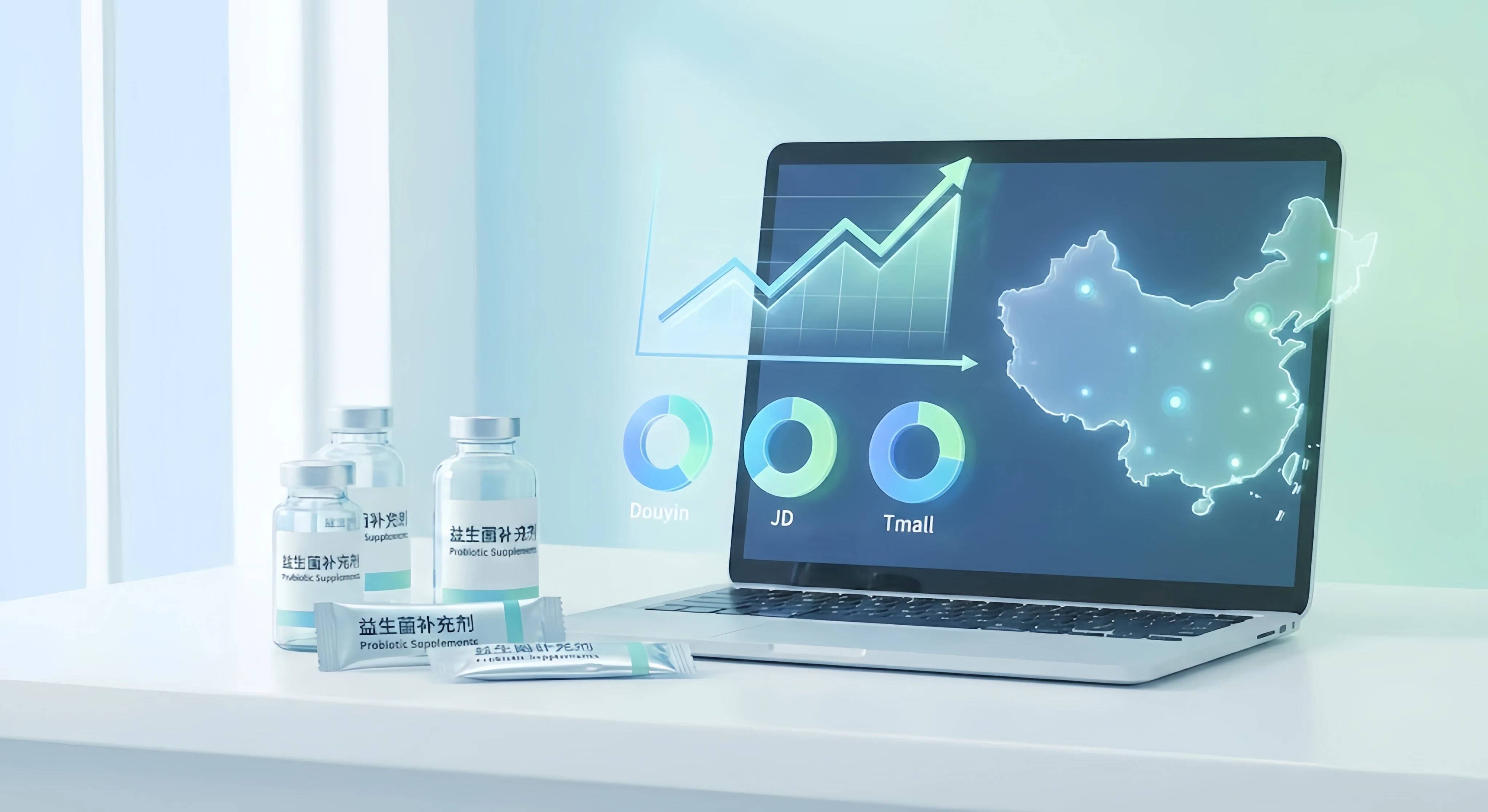
2.2 Platform Breakdown: Douyin Dominates, JD and Tmall Provide Stability
Probiotic traffic and transactions in China are now highly concentrated on three major platforms:
-
Douyin: ~48.2% share
-
JD.com: ~23.4% share
-
Tmall: ~18.8% share
This structure reflects a clear division of roles:
-
Douyin has become the primary battleground that sets the rhythm for the entire probiotic industry. Short-video education, livestream selling, and influencer-led “problem/solution” narratives make it ideal for pushing new concepts, niche functions, and bundles (e.g., probiotics + sleep, probiotics + weight management).
-
JD.com and Tmall play the role of standardized, high-repurchase transaction hubs. Consumers who have already formed habits—such as buying the same gut-health probiotic every month—often turn to these shelf-based platforms for repeat purchases, price comparison, and subscription-style buying.
Analysis:
For brands and manufacturers, this means that China’s probiotic growth is channel-dependent and content-driven. Winning on Douyin requires strong storytelling and scenario-based positioning, while success on JD/Tmall depends more on product reliability, reviews, subscription mechanisms, and operational efficiency.
3. Functional Demand: Niche Benefits Are Exploding
If channels determine the vehicle of growth, then functional demand determines its quality and durability.
From November 2024 to October 2025, several niche probiotic benefits showed remarkable year-on-year growth:
-
Emotional health / mood support: +421.7%
-
Sleep support: +349.0%
-
Metabolism support: +167.1%
Although the absolute sales scales of these segments are still relatively small, their growth logic is very clear:
-
Rising stress and anxiety among young consumers
Urban young adults in China are under chronic pressure from work, social expectations, and financial stress. Emotional imbalance, mild anxiety, and mood swings are common. -
Sleep disorders and high-pressure lifestyles
Irregular schedules, long screen time, and late-night working contribute to sleep latency and poor sleep quality, which are now widely recognized problems. -
Demand for “gentle, long-term management” solutions
Compared with drug-like interventions, probiotics are viewed as gentle, non-addictive, and suitable for continuous use—a natural fit for “light intervention, long-term management” scenarios.
As a result, probiotics in China are evolving from a single-purpose “gut health tool” into multi-dimensional solutions covering:
-
Gut health
-
Mood and emotional balance
-
Sleep quality
-
Metabolic health and weight management
Weight Management: Combining Metabolism and Lifestyle
Within functional probiotics, weight-management-related benefits are particularly noteworthy:
-
Probiotic SKUs with fat-loss or body-shaping claims grew +46.7% year-on-year.
-
A typical high-growth scenario is the combination of “metabolic probiotics + intermittent fasting + weight management program.”
This shows that consumers are increasingly receptive to systemic solutions, rather than single products. Probiotics are embedded as part of a broader lifestyle plan, not sold in isolation.
Analysis:
For formulation and product pipeline planning, this shift suggests clear opportunities in multi-benefit probiotic formulas (e.g., gut + mood, gut + sleep, gut + metabolic health), especially when supported by clear usage protocols and behavioral guidance.
4. Gut Health: Still the Largest Segment, But Growth Has Peaked
Despite the rise of niche benefits, gut health remains the core functional base of the probiotic category:
-
From November 2024 to October 2025, gut-focused probiotics generated about RMB 5.4 billion in sales, the largest share among all functions.
-
However, in October 2025, gut-health probiotic sales declined slightly, by –0.1% year-on-year.
This indicates that the gut-health segment is now in a “high-penetration, low-growth” mature phase:
-
It plays the role of a stable base, supporting brand volume and long-term repeat purchases.
-
It is less likely to be the primary source of incremental category expansion going forward.
Analysis:
For brands, gut-health probiotics should be treated as foundational SKUs—critical for credibility and stability—but not sufficient as the main engine of future growth. Incremental gains will increasingly come from layering new benefits (mood, sleep, metabolism, immune modulation) on top of the gut-health base.
5. Women’s Probiotic Market: A Core Segment Under Pressure
Women remain one of the most important consumer groups for probiotics in China. However, data from November 2024 to October 2025 shows that the women’s probiotic segment is experiencing short-term pressure:
-
Total probiotic sales to female consumers during this period were about RMB 1.9 billion, down 11% year-on-year.
-
In October 2025, monthly sales reached around RMB 170 million, but plunged 28% year-on-year.
Several factors may be contributing:
-
Category fatigue in traditional “women’s probiotics,” which often repeat similar gut + gynecological health claims without strong differentiation.
-
Intensifying competition from other categories (e.g., enzyme drinks, fiber products, functional herbal blends) that also target weight, digestion, and skin.
-
Price wars and promotional dependency, which erode perceived value and make consumers more selective.
Analysis:
Rather than treating “women” as a broad label, successful brands increasingly target specific female life scenarios, such as:
-
Recurrent intimate discomfort and microbiome imbalance
-
Post-antibiotic gut and vaginal flora recovery
-
Mood and sleep issues related to hormonal cycles
-
Postpartum recovery or weight management
The opportunity lies in designing precise, scenario-driven female probiotic solutions, instead of generic “for women” SKUs.
6. High-Growth Brands: Functional Focus + Scenario Targeting as a Shared Playbook
Comparing sales in October 2024 vs. October 2025, the top-growing probiotic brands in China share two consistent traits:
-
Highly specific functional positioning
-
Clear, concrete usage scenarios
6.1 Leading High-Growth Brands: Matrix Expansion
Wanyilan (万益蓝)
-
Sales (Jan–Oct 2025): ~RMB 1.8 billion
-
October 2025 year-on-year growth: +64.2%
-
Product strategy: covers gut health, metabolism, children’s probiotics, women’s probiotics, and other lines.
-
Brand type: a classic “full-scenario matrix brand”, aiming to cover all major consumer groups and core functions.
Shu Bote (舒伯特)
-
Sales (Jan–Oct 2025): ~RMB 170 million
-
October 2025 year-on-year growth: +68.0%
-
Product strategy: focuses specifically on stomach concerns such as indigestion, bloating, and discomfort.
-
Brand positioning: “stomach-specialist probiotics”, building a very clear and memorable consumer perception.
These head brands share a common feature: they pursue long-term, scalable growth by:
-
Building complete coverage across major consumer groups
-
Maintaining clear lines for different functions
-
Using China’s main e-commerce channels to replicate success across multiple SKUs
6.2 Mid-Tier Breakout Brands: Single-Scenario Penetration
Lingxian (领纤)
-
Year-on-year growth (Jan–Oct 2025): > +2000%
-
Core focus: fat-loss and intimate care (“slimming + feminine care”)
NenyI (嫩益)
-
Year-on-year growth (Jan–Oct 2025): > +7000%
-
Core focus: fat-loss scenarios, with highly concentrated messaging.
The core logic for these mid-tier brands is very consistent:
-
They do not start by trying to serve “all functions.”
-
Instead, they go deep into one very specific, high-frequency usage scenario, such as:
-
“Stubborn constipation + fat-loss”
-
“Recurring intimate sensitivity + microbiome care”
-
In essence, this is a “symptom-level scenario entry + high-repurchase demand capture” strategy, rather than a traditional “multi-function stacking” product approach.
Analysis:
For new or mid-tier brands—whether local or overseas—the most realistic path to winning in China’s probiotic market is not to copy large, multi-line incumbents. Instead, it is to:
-
Identify a precise, underserved scenario
-
Build a probiotic-centered solution (often with supporting ingredients)
-
Communicate it clearly through content-rich channels like Douyin and Xiaohongshu
-
Only consider broader line expansion after establishing dominance in that initial niche
7. Strategic Takeaways for Brands and Manufacturers
From a strategic perspective, the 2024–2025 performance of China’s probiotic market suggests several key directions:
-
Treat probiotics as a platform, not a single product
Future growth will come from building probiotic-based platforms around emotion, sleep, metabolism, and weight management, not just standalone gut-health capsules. -
Design for scenarios, then for functions
High-growth brands consistently start from specific real-world situations—like “high-stress office worker with poor sleep”—and then back-solve the functional formula. -
Differentiate by evidence and protocol
As more SKUs crowd into the same benefit spaces, brands will need clearer evidence, more transparent dosage communication, and structured usage protocols to sustain pricing and loyalty. -
Collaborate with flexible, high-capability manufacturers
To support rapid iteration and multi-scenario portfolios, brands need manufacturing partners who can:-
Work with diverse strains and complex blends
-
Ensure stable quality and regulatory compliance for China and export markets
-
Offer flexible batch sizes and fast scaling once a formula takes off
-
-
Prepare for a more segmented, less forgiving market
With gut-health growth plateauing and women’s probiotics under pressure, the market will reward brands that can read data quickly, pivot positioning, and innovate around new consumer pain points.
Here is a polished version of the disclaimer:
Strengthening Confidentiality Obligations and Disclosure Requirements: The information in this article is collected from official and publicly available sources and does not constitute any recommendation or guarantee for investment or business decisions. The content is for reference only and does not amount to professional advice of any kind. Before making any investment or business decision, you should consult qualified professionals in the relevant fields. The author and Early Data shall not be liable for any direct or indirect losses arising from the use of the information contained in this article.