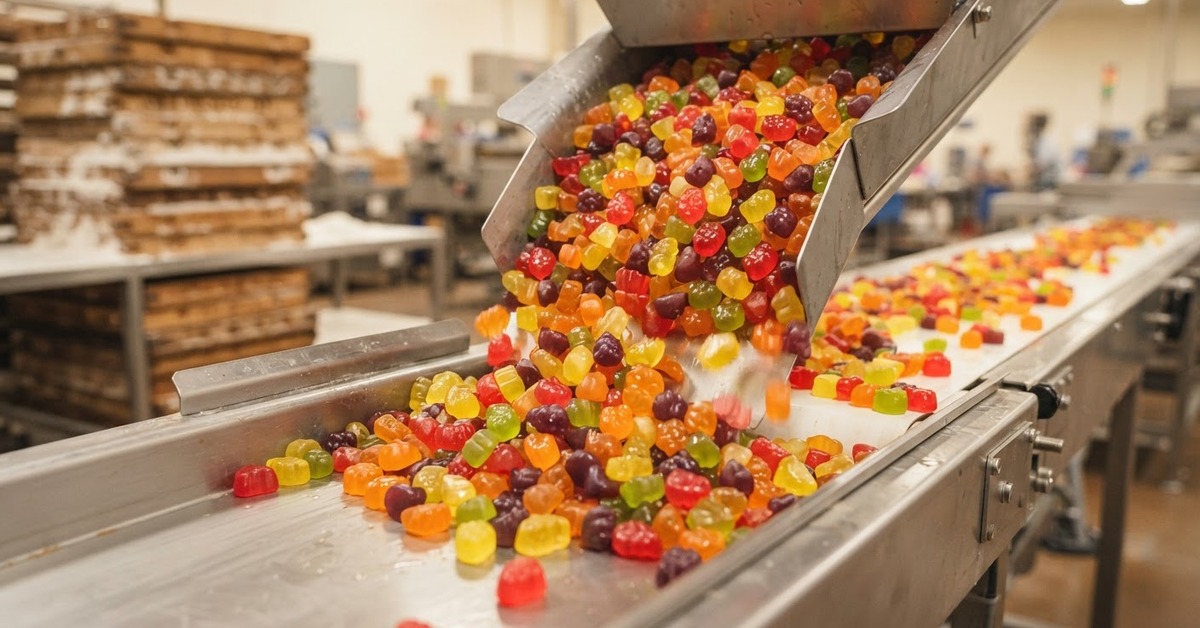

Nutraceutical Gummy Manufacturer: How Gummy Manufacturing Works
Gummies have become the fastest-growing dosage form in the supplement industry, and it is not hard to see why. They are easy to take, easy to carry and easy to sell — which makes "nutraceutical gummy manufacturer" one of the most searched supplier terms among new brand owners. But gummies are also one of the hardest formats to produce consistently, and the gap between a good gummy and a bad one is almost always a manufacturing decision rather than a marketing one.
This guide covers how a nutraceutical gummy manufacturer turns a formula into a finished product, what actually drives cost and lead time, and how to evaluate a partner before you commit to a production run.
What is a nutraceutical gummy manufacturer?
A nutraceutical gummy manufacturer produces chewable, food-format supplements that deliver functional ingredients — vitamins, minerals, botanicals, collagen, probiotics, omega-3 and more — in a gelatin or pectin base. The manufacturer is responsible for formulation, ingredient sourcing, cooking and depositing, drying, quality control, and packaging into the jar or pouch that reaches the consumer.
Unlike a capsule or tablet line, a gummy line has to solve three problems at once: taste, texture and stability. Get any one wrong and the product fails — either in the mouth, in the warehouse, or on the shelf.
Gelatin vs pectin gummies
The base decides almost everything that follows.
- Gelatin gummies give the familiar chewy, springy bite. They are cheaper per unit and easier to run at high speed, but they are not vegetarian and are unsuitable for halal or kosher claims unless a certified beef or fish gelatin is used.
- Pectin gummies are plant-based, which makes them suitable for vegan, halal and kosher positioning. Pectin sets differently, so texture must be tuned carefully, and production is generally slower and slightly more expensive.
- Starch-moulded gummies offer a softer bite and excellent ingredient stability, which matters for heat-sensitive actives.
The base also interacts with the active ingredient. Acidic actives such as vitamin C can weaken gelatin over time, while some minerals and botanicals affect colour and flavour. A manufacturer with real experience will flag these conflicts at the formulation stage, not after the batch has been made.
Why gummies are hard to manufacture consistently
Three variables separate a stable commercial gummy from a failed one:
- Moisture and water activity. Gummies release and absorb moisture. If water activity is not controlled, the gummy either sweats, sticks together or dries out and hardens before the end of shelf life.
- Heat exposure. Cooking and depositing involve heat, and many nutraceutical actives — probiotics, certain vitamins, omega-3 — degrade when heated. Overages and protective systems have to be calculated properly, not guessed.
- Dose uniformity. A gummy must deliver the labelled amount of active per piece. Uniformity depends on mixing discipline and moulding accuracy, and it is one of the first things a retailer or regulator will test.
This is why "we make gummies" is not the same as "we can make your gummy". Ask any prospective partner how they control water activity and how they validate dose uniformity across a full batch.
Custom vs private label gummies
There are two routes into the market:
- Private label (stock formula): you choose from an existing gummy formula — multivitamin, collagen, biotin, probiotics, apple cider vinegar, melatonin and so on — and apply your own branding and packaging. Faster and cheaper, but your product is not unique.
- Custom formulation: the manufacturer develops a formula to your specification, including your actives, dosages and flavours. This is how brands build something defensible. It takes longer and costs more up front, but the formula can be owned and protected.
Many successful launches start hybrid: a private label SKU to get to market, followed by a custom SKU once demand is proven.
Nutraceutical gummy manufacturing specifications
Typical commercial parameters, using a Guangzhou-based GMP-certified facility as the reference:
| Item | Typical specification |
|---|---|
| Base | Pectin (vegan), beef or fish gelatin, or starch-moulded |
| Piece weight | 2–5 g per gummy |
| Count per bottle | 60–120 pcs |
| Sugar options | Standard, low-sugar, sugar-free (polyol or fibre-sweetened) |
| Flavours | Natural or nature-identical, multi-flavour runs possible |
| Actives | Vitamins, minerals, collagen, probiotics, omega-3, botanicals |
| MOQ | 20,000 pcs per SKU (sample batches negotiable) |
| Lead time | 5–7 weeks after formula and artwork approval |
| Packaging | PET jar, pouch, sachet, blister or stick pack |
What drives gummy cost
Five factors decide the unit price, roughly in this order:
- Active ingredients. Premium or branded actives — chelated minerals, branded probiotic strains, liposomal systems — can dominate the cost.
- Base and sugar system. Pectin and sugar-free systems cost more than standard gelatin and sugar.
- MOQ. A 20,000-piece run absorbs setup and cleaning costs over fewer units than a 200,000-piece run.
- Packaging. Jar, lid, label and carton minimums are often the hidden part of the quote.
- Testing. Third-party analysis for potency, microbiology and heavy metals adds cost but is non-negotiable for most markets.
Be wary of a quote that is dramatically cheaper than the others. It usually means untested actives, an unqualified use of overages, or component minimums that appear later.
How to choose a nutraceutical gummy manufacturer
A practical checklist:
- Certification scope. Confirm GMP, ISO 22000 or HACCP on the certificate itself, and ask which products and lines are covered.
- Pectin and gelatin capability. If you need vegan, halal or kosher positioning, confirm the facility can run the relevant base and has the documentation to support the claim.
- Stability data. Ask for water activity targets and shelf-life testing rather than a verbal assurance.
- Dose uniformity records. A serious manufacturer can show you batch results for active content per piece.
- MOQ and scalability. Confirm the same partner can take you from 20,000 to 500,000 pieces without changing site or process.
- Documentation turnaround. Request a sample specification, COA template and ingredient traceability record during the evaluation, not after the order.
- Communication. One accountable contact with predictable response times matters more than the size of the factory.
Brands comparing suppliers often find that price differences between serious facilities are far smaller than the differences in what those facilities can prove. A slightly higher quote with documentation and stability data is almost always the cheaper decision in the long run.
Let's talk about your gummy
ZOOMSHEAL Health has manufactured nutraceutical gummies, capsules, softgels, tablets, powders and liquids in Guangzhou since 2003. We run pectin and gelatin gummies, sugar-free and vegan options, custom formulation and private label programs, with MOQ from 20,000 pieces and lead times from five weeks.