
Most brands choose a manufacturer on price, samples and a video call. Then they find out two years later - usually from a customer complaint or a marketplace notice - what nobody checked.
There is a better order. Understand what a regulator looks at, then run the same checklist yourself for two days before you sign anything.
What an FDA inspection actually examines
Under the dietary supplement GMP rule, an inspection is not a product test. It is an examination of the system that produced the product. Inspectors follow the batch record backwards and forwards:
- Was the master manufacturing record complete before production started?
- Does the batch record show every component, weight and yield, signed at each step?
- Were components tested or verified by certificate before use, and is the certificate tied to the lot?
- Do the finished product specifications exist, and did the batch actually meet them?
- Was every deviation documented and investigated?
- Are complaints logged, reviewed and trended?
- Is the equipment cleaned, and is the cleaning verified?
- Can the plant show training records for the people who signed the records?
The pattern is documentation of control. A factory can make a good product and still fail the inspection, because it cannot prove how it made it.
The observations that keep repeating
At the end of an inspection, the investigator issues a list of observations on Form 483. The same categories recur across the industry:
| Observation | What it looks like in practice |
|---|---|
| Master manufacturing record incomplete | Missing step, missing theoretical yield, unsigned |
| Batch production record not followed | Operator skipped a step, no deviation raised |
| Component identity not verified | Supplier certificate accepted without qualification |
| Specifications not established | No written finished product spec to test against |
| Equipment not cleaned or verified | Cleaning log missing for a changeover |
| Complaint handling inadequate | Complaints filed but never investigated or trended |
| Training not documented | Staff doing the task, no record of qualification |
None of these are exotic. All of them are paperwork failures around real production, which is precisely why they are the right thing to ask about. A factory that can show you a clean recent inspection, and a written corrective action for anything found, is a different supplier from one that has never been inspected and cannot tell you why.
A Form 483 is not a recall
The distinction matters when a factory tells you its compliance history.
- Form 483 is a list of observations. It is not a finding of violation, and many are resolved with a written response.
- Warning letter is issued when the agency considers the violations significant. It is public, and it comes with a deadline for correction.
- Recall is a product action, classified by health hazard, and it is usually triggered by a defect the system failed to catch.
Ask for all three. A plant that has never had an observation at all is either very good or very young. A plant that cannot produce its inspection history is a risk.
What a brand should ask before signing
Five questions, in writing:
- When was your last regulatory inspection, and can I see the observations and your response?
- Which third-party certifications do you hold, and are they current? Request the certificate numbers, not the logos.
- Can I see a redacted batch record for a product similar to mine?
- What are your change control rules if you switch a supplier of an excipient mid-year?
- Who is responsible for the finished product specification, and can I approve it?
Question three is the one that separates suppliers. A factory that will show a redacted batch record is confident in its records. A factory that will not is telling you something.
What a batch record actually contains
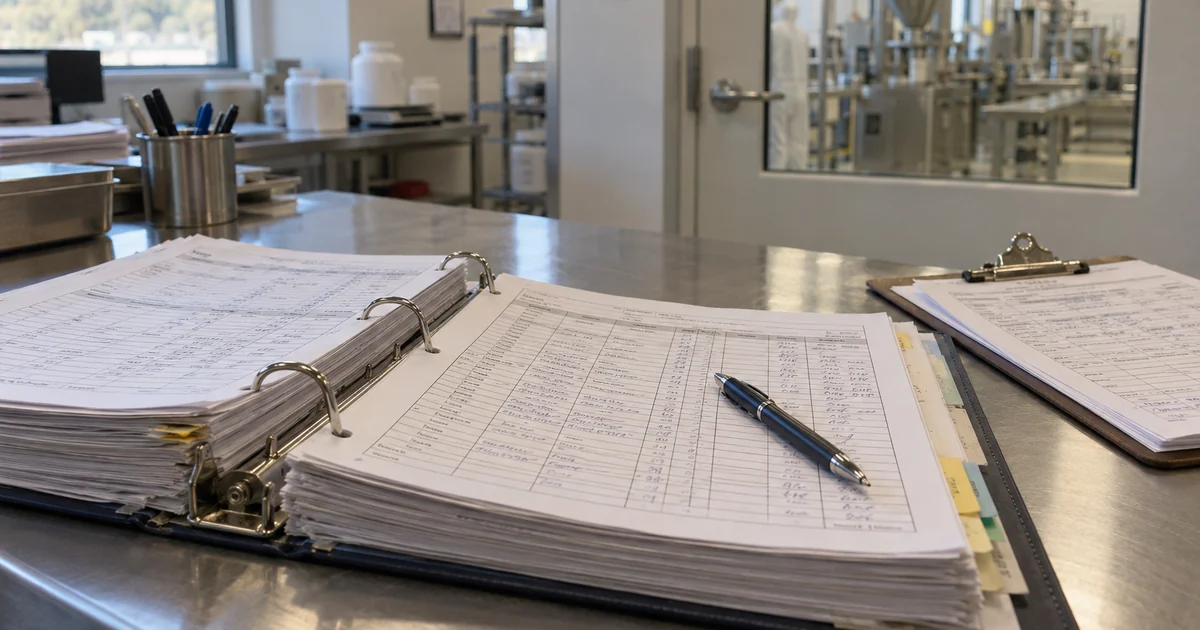
If you only learn one document, learn this one. A complete batch record for a supplement lot should let a stranger remake the batch:
- The master record version it was made against, with the effective date.
- Every component: identity, supplier, lot number, weight or measure, dispensed by, verified by.
- The theoretical yield and the actual yield, with a tolerance.
- The in process checks: weight, hardness, disintegration, fill weight, seal integrity, metal detection, as applicable.
- Every deviation, with an investigation note and a disposition.
- Cleaning and line clearance confirmation for the equipment used.
- The finished product test results against the specification, and the release signature with a date.
Two details matter more than the rest. The dual verification on component weighing, because that is where mix ups happen. And the deviation section, because a batch record with no deviations at all, over hundreds of batches, is not a clean record. It is a record that is not being written honestly.
Ask for a redacted copy of one record for a product close to yours. You are not looking for a perfect document. You are looking for evidence that the document is real: handwriting, initials, dates that line up, and a yield that is plausible.
Which certification answers which question
Certifications are not interchangeable, and each one only tells you something specific:
| Certification | What it actually covers |
|---|---|
| GMP (third party) | The facility and quality system meet a defined standard |
| ISO 22000 or | Food safety management, usually with a retail supply chain focus |
| NSF or UL | Product or facility certification with ongoing surveillance |
| Informed Sport or Informed Choice | Batch testing for substances banned in sport |
| Organic | Ingredient and process chain, inspected annually |
| Halal | Ingredients, facility and process, certified by a religious authority |
A brand selling to athletes needs batch level banned substance testing, which a GMP certificate does not provide. A brand selling into the EU needs the label and contaminant story, which no certificate replaces. Match the certificate to the claim you intend to make, and request the certificate number and expiry rather than accepting the logo.
The two day audit
If you visit, spend the time in this order. The plant tour is the least informative part.
| Time | What to do | What you are looking for |
|---|---|---|
| Half day | Records room | Batch records, deviation log, complaint log, training files |
| Half day | Receiving and quarantine | Are incoming components held until released, physically separated |
| Half day | Production floor | Changeover cleaning, line clearance, operators following the record |
| Half day | QC lab | Calibration stickers, method documents, sample retention |
| Two hours | Warehouse | Retention samples, label control, rejected material segregation |
Bring one product with you and ask to see its full trace: purchase order, component certificates, batch record, in process checks, finished product test, release signature. Following one lot end to end tells you more than any presentation.
Things worth noticing without asking: are the bins labelled, is there a quarantine area that is actually used, does the lab have calibration dates in the future, and does anyone hesitate when you ask for a document.
Why recalls happen, and who pays
A recall usually traces back to one of four causes: a component that was not what the certificate said, a label that did not match the formula, a microbial or heavy metal result that was never tested, or a process deviation nobody caught. The testing side of that is in our guide to reading a certificate of analysis, which is also the document an auditor will ask for first.
The regulatory cost is the visible part. The commercial cost is larger: marketplace suspension, retailer chargebacks, freight for the return, destruction, and the replacement run. Contracts usually allocate this, and the allocation is worth reading before you need it. If the contract is silent on who pays for a recall caused by a manufacturing defect, it is silent in the factory's favour.
Red flags that end the conversation
- No batch record available for review, at any level of redaction.
- Certificates presented as logos on a website with no certificate number.
- A certificate of analysis that is not lot specific.
- Quarantine area that is a corner of the production floor.
- Deviation and complaint logs that are empty. Empty logs mean nobody is recording, not that nothing happens.
- A factory that cannot explain what happens when a batch fails.
Frequently asked questions
Do I need to audit my manufacturer myself?
Not necessarily, but you need evidence someone did. A credible third-party GMP certificate plus a records review covers most of it. What you cannot do is rely on a logo alone.
How long does a GMP audit take?
A focused supplier audit is two days for a single site. A full certification audit is longer and is done by the certification body, not the customer.
Is a GMP certificate the same as an FDA inspection?
No. GMP certification is issued by a third party against a standard. An FDA inspection is a regulatory event with its own outcome. Both are useful and they answer different questions.
What if the factory refuses an audit?
That is an answer. A factory that will not allow a customer audit, or will not share its inspection history, is asking you to take on risk you cannot see.
Can a small brand ask for this?
Yes, and small brands should ask earlier rather than later. The batch record you cannot see is the one that becomes your recall.
The takeaway
Auditing a manufacturer is not a formality and it is not only about the plant. It is a records exercise: prove the lot, prove the test, prove the release. Do it before the first purchase order, once a year after that, and always after a change of ownership or a new production line.
If you are comparing suppliers, ask each one for the five documents above and compare the answers. Send us the same request - we will give you the inspection history, the certificate numbers and a redacted batch record, and you can judge the difference yourself. Brands moving an existing line can start with our private label range, where the release documents come with the first quote.