
There are two prices in this business and most new brands only know one of them.
The first is what it costs to make the product. The second is what someone will pay for it. They are connected, but not the way most founders assume: the factory price does not set your retail price, and your retail price does not tell you whether you can afford to sell it.
This is the build-up, with real numbers, for the four channels you are likely to use.
The short answer
Price from landed cost upwards, not from retail downwards.
- Landed cost per unit = formula + packaging + filling + testing + freight + duty
- Wholesale price = landed cost x 2.2 to 2.6 (for retail channels)
- Retail price = wholesale x 2.0 to 2.5 (keystone, what a shop needs)
- For direct-to-consumer, retail is yours to set, but the fees replace the retailer
If you start with "I want to sell at 19.99" and work backwards, you will discover in month four that the product cannot be made for the money you left on the table.
A worked example, 60-count capsules
A straightforward single-ingredient capsule, made in Asia, sold into the US. Ranges reflect a 1,000-unit first run versus a 5,000-unit reorder.
| Cost line | Per unit at 1,000 | Per unit at 5,000 |
|---|---|---|
| Formula and actives | 1.35 | 1.10 |
| Bottle, cap, seal | 0.43 | 0.28 |
| Label and carton | 0.63 | 0.29 |
| Filling and QC | 0.45 | 0.30 |
| Third-party testing (allocated) | 0.18 | 0.06 |
| Freight, insurance, duty | 0.52 | 0.26 |
| Landed cost | 3.56 | 2.29 |
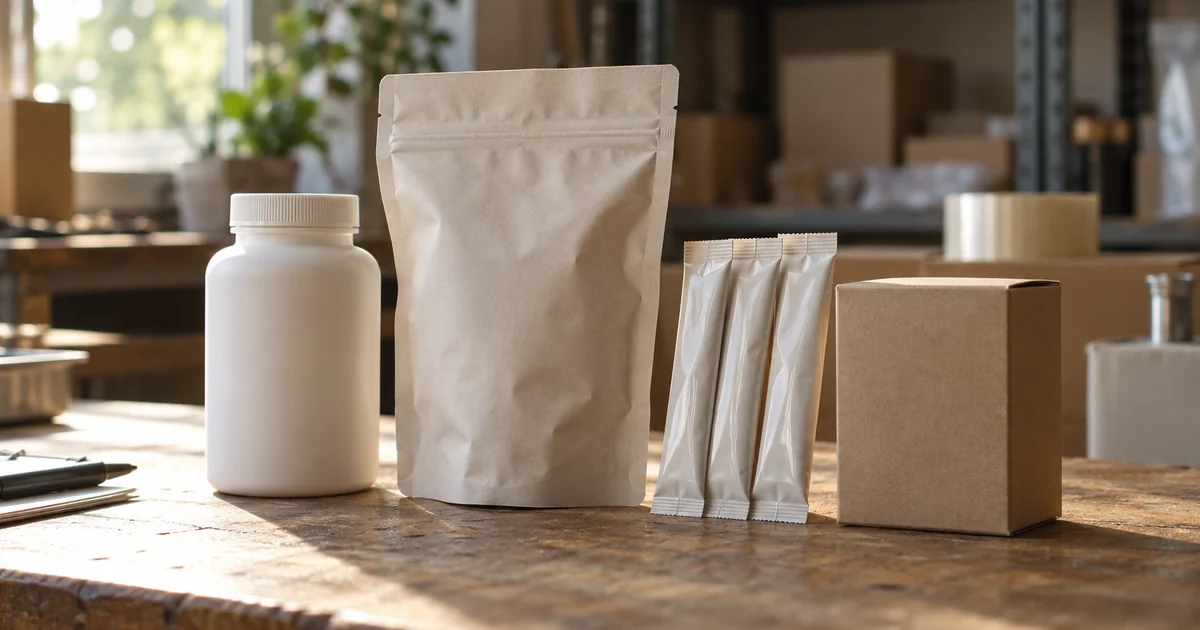
Packaging is the line most founders underestimate; there is a full breakdown of what each format adds in supplement packaging cost per unit, and the volume mechanics behind it are in supplement MOQ explained.
That is the number you must know before you talk about price. Not the factory quote, which stops at ex-works, and not the "cost per bottle" a supplier quotes on a slide, which usually excludes freight and duty.
The channel stack
The same 2.29 USD unit travels through very different margin structures depending on where it is sold.
| Channel | What you receive | Who takes what | Typical net per unit |
|---|---|---|---|
| Direct to consumer (own site) | Retail price | Payment 3 percent, shipping and fulfilment 4 to 7, ads 15 to 30 percent of revenue | 12 to 17 at a 29.99 retail |
| Amazon (FBA) | Retail price | Referral 15 percent, FBA fee 4 to 6, ads 10 to 20 percent | 8 to 13 at a 29.99 retail |
| Specialty retail | Wholesale | Retailer takes 45 to 55 percent of shelf price | 12 to 15 at a 29.99 shelf price, if your wholesale is 13.50 |
| Distributor into retail | Wholesale minus distributor margin | Distributor takes 25 to 35 percent of your wholesale | 9 to 11 at the same shelf price |
Two things follow from that table.
Retail is not automatically the most profitable channel. It is the most expensive to enter, because you carry the cost of samples, free fill, slotting and slow payment, and you hand over half the shelf price.
Amazon is not free money either. After referral fees, fulfilment and advertising, the net is closer to a wholesale channel than to direct sales, and you do not own the customer.
Working backwards from a shelf price
If a retailer will stock your product at 29.99, here is what that allows you to spend.
| Shelf price | Retailer margin | Your wholesale | Max landed cost for 50 percent gross margin | Max landed cost for 60 percent |
|---|---|---|---|---|
| 19.99 | 45 percent | 11.00 | 5.50 | 4.40 |
| 29.99 | 50 percent | 15.00 | 7.50 | 6.00 |
| 39.99 | 50 percent | 20.00 | 10.00 | 8.00 |
| 49.99 | 55 percent | 22.50 | 11.25 | 9.00 |
Now compare with the landed cost table: a 2.29 to 3.56 USD product fits comfortably at 29.99 wholesale, and has enormous room at 39.99. The same product at 19.99 with a distributor in the middle does not work at all, which is why you see so many cheap-looking products in discount channels and premium-looking ones in health stores. It is the same factory.
Why the same capsule sells at 19.99 and 49.99
It is not the formula. At this level, the difference is almost always:
- Dose and number of actives. A 60-count single ingredient is a commodity; a 120-count five-ingredient blend with clinical doses is not.
- Format. Gummies and stick packs cost more to make and support a higher shelf price than capsules.
- Certification. Organic, NSF, Informed Sport and third-party tested claims cost money and justify price.
- Brand and story. A brand with a point of view can charge double for the same pill. This is the largest single lever and the one a factory cannot give you.
- Channel. The same product in a gym, a pharmacy and a marketplace is three different prices.
What you should not do is price against the cheapest thing on Amazon. That price is usually a seller liquidating stock, not a business model.
The three numbers that decide survival
Unit margin alone will not tell you whether the brand works. Track these:
- Gross margin per unit, after all landed costs. For DTC, you want 65 percent or better before ad spend. For wholesale, 45 to 50 percent is workable. Below 40 percent on a first run, every mistake becomes fatal.
- Customer acquisition cost versus first-order profit. If it costs 22 USD in ads to get a 29.99 order with a 15 USD gross margin, you lose money on the first order and need a repeat purchase to break even. That is a real model, but only if repeat rate is high.
- Repeat rate at 60 and 90 days. A 30-day supply with 35 percent repeat at 60 days is a business. Ten percent is a promotion.
Margin is not cash: the payment terms trap
A 50 percent gross margin on paper can still run you out of money, because the channels pay at different speeds.
| Channel | When you get paid | What it means |
|---|---|---|
| Direct to consumer | Immediately | You fund ads, then get cash in days |
| Amazon | About 14 days after settlement | Manageable, but reserves are held |
| Specialty retail | 30 to 60 days after delivery | You pay the factory first, then wait |
| Distributor | 60 to 90 days | You are effectively lending them the goods |
Add the factory's deposit, which is typically 30 to 50 percent at order, and a retail launch can leave you 10,000 to 30,000 USD out of pocket for two months on a single SKU. Price the margin correctly, then check that you can survive the gap between paying for the goods and being paid for them.
Five pricing mistakes that show up in every first launch
- Quoting ex-works as landed cost. Freight and duty on a 1,000-unit sea shipment can add 15 to 25 percent. On air, more.
- Pricing on the first run. A 1,000-unit run is the most expensive unit you will ever make. Price on the steady-state cost at 5,000, but budget cash on the first run cost.
- Forgetting the packaging reprint. Labels are printed in the thousands. A price that assumes you reprint at will is a price that assumes a cost you have not paid.
- Matching the market leader's retail price without their cost base. They buy actives at volumes you cannot access and ship in containers.
- Discounting to launch. A launch discount trains your first customers to wait for the next one, and it compresses the margin you need for ads.
How to price a first run properly
Three legitimate options, in order of preference:
- Price for the channel you can actually serve. If you are selling DTC, you do not need retail margins at all. Set the price at 2.5 to 3 times landed cost and reinvest the difference in acquisition.
- Reduce pack size for the first run. A 30-count at a lower price point gets you a first order and a repeat purchase faster than a 120-count at a premium.
- Accept a thinner margin on run one and fix it on run two. This works only if you know the run-two cost in advance and your price already supports it. Write the target landed cost into your plan, not just the wish.
Do not solve a margin problem with a lower price. Solve it with a better pack, a better dose story, or a channel that pays you properly.
Frequently asked questions
What is a good gross margin for a supplement brand?
Direct to consumer, 65 to 75 percent before advertising is normal and healthy. Wholesale, 45 to 55 percent. Anything under 40 percent leaves no room for returns, chargebacks or a bad batch.
Should I sell on Amazon or my own site first?
Start where you can control the price and keep the customer data. Use Amazon once you know the product converts, because the ad cost there is a tax on learning.
How much does a retailer expect to make on my product?
Plan on the retailer taking 45 to 55 percent of the shelf price, and a distributor taking another 25 to 35 percent if one is involved. That is why your wholesale must be roughly a third to a half of shelf.
Is it cheaper to make a premium product?
No, but it is often more profitable. A higher dose or a certified ingredient might add 0.40 USD to landed cost while supporting a 10 USD higher shelf price.
Can I change my price after launch?
You can raise it, but expect a conversion dip and a few angry reviews. It is much easier to launch at the right price with a launch offer than to correct a low price later.
The takeaway
Price is a build-up from landed cost, filtered through the channel that actually pays you. Know your landed cost at 1,000 and at 5,000, know what each channel keeps, and pick the price that leaves enough margin to buy your next customer. The factory can make the product cheaper; only you can decide whether the price works.
Send us your target retail price and channel and we will tell you honestly whether the product can be made for it - and what would have to change if it cannot. Most of the time the answer is a different pack size, a different MOQ or a private label format rather than a cheaper formula.