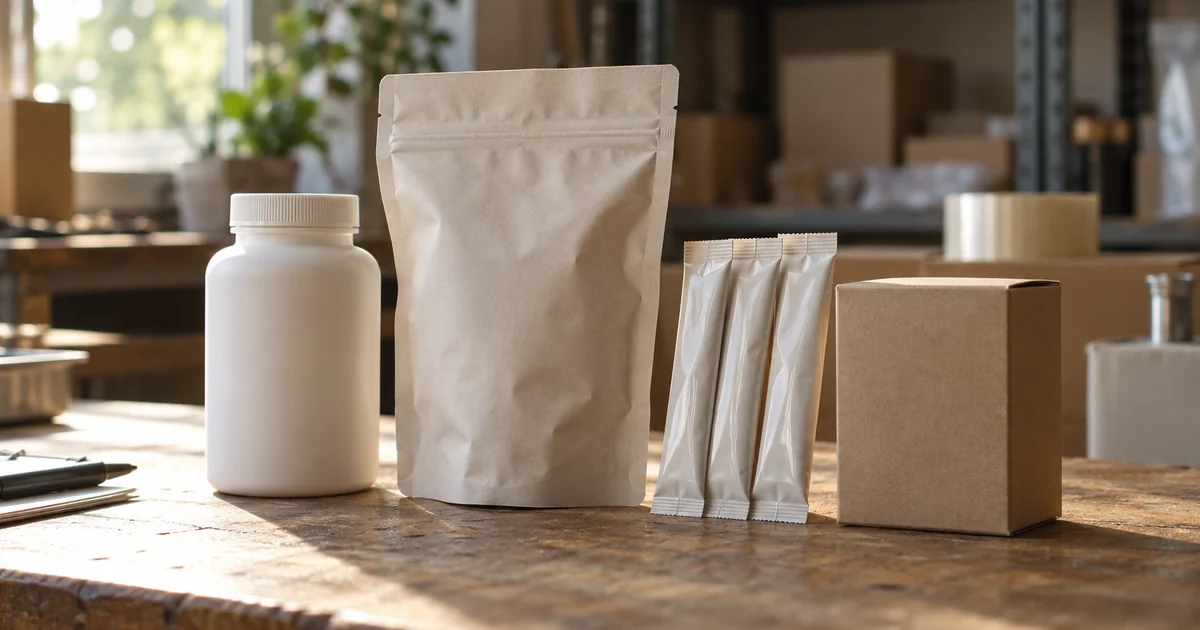

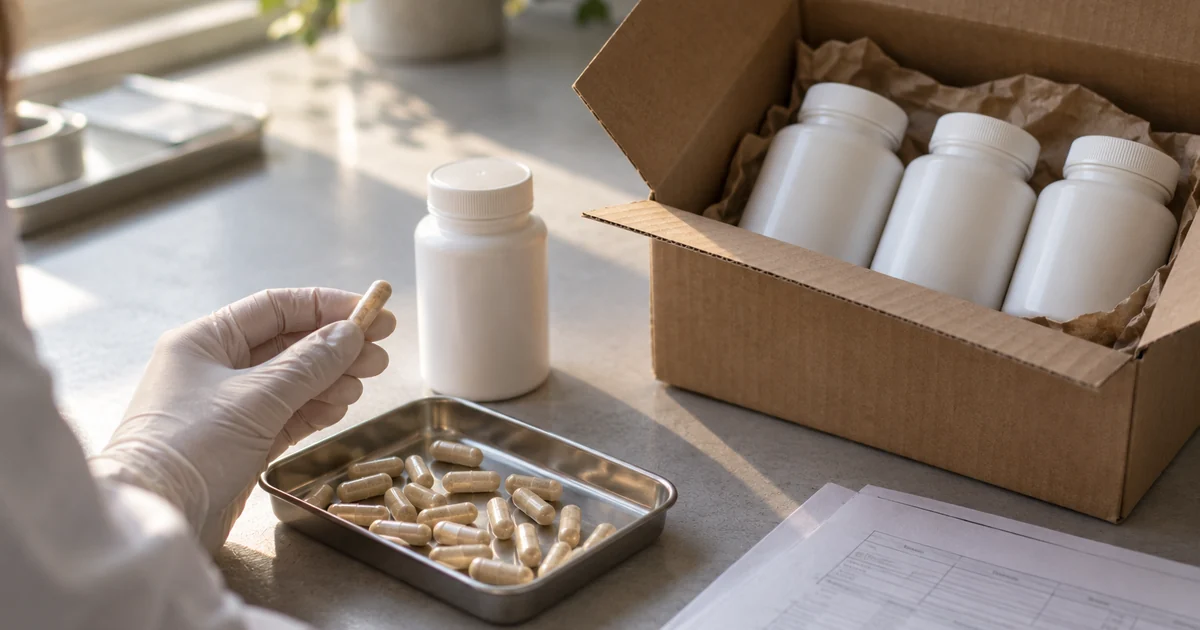
Almost every supplement brand starts with a sample request, and almost every brand evaluates the sample wrong.
The box arrives, someone opens a bottle, tastes a capsule, takes a photo for the group chat, and the decision gets made on flavour and packaging. Three months later the production batch behaves differently from the sample, and nobody can explain why.
A sample is not a preview of the product. It is a preview of a process. What you are really evaluating is whether the factory can hit your specification twice, on their real equipment, with a real ingredient lot. Everything else is marketing.
The short answer: four things people mean by "sample"
The word covers four very different objects, with different lead times and different price tags. Ask which one you are being offered before you read the quote.
| Type | What you receive | Typical lead time | Typical cost (USD) | What it actually proves |
|---|---|---|---|---|
| Stock formula sample | Their existing product, their label | 3 to 7 days | free, you pay freight (30 to 90) | Whether you like their platform formula |
| Custom trial batch | Your formula, small run, often hand or pilot line | 2 to 4 weeks | 300 to 1,500 | Whether the formula works at all |
| Pilot or scale-up batch | Your formula on production equipment, 1/10 scale | 4 to 6 weeks | 800 to 3,000 | Whether it works on their real line |
| Pre-production validation batch | Full batch, released against your spec | 4 to 8 weeks | batch price plus premium | Whether you can sell it |
Most first-time buyers think they are ordering the fourth one and receive the first one. That mismatch is the source of most disappointment in this industry.
What a proper sample kit contains
A good manufacturer sends more than a bottle. If the box has only product, ask for the rest before you evaluate anything.
- The sample itself, in the final dosage form, in a container close to the intended pack
- A specification sheet: fill weight, capsule size, disintegration, moisture, appearance
- A certificate of analysis for the trial batch, ideally from an outside lab
- A label draft or mock-up, so you can check the Supplement Facts panel against the actual fill
- Packaging options with MOQ and price per unit for each
- A stability statement: what data exists, and what would need to be generated
- A written quote with first-order MOQ, reorder MOQ, lead time and Incoterms
If you get a bottle and a price per unit, you are talking to a broker, not a manufacturer.
What "free samples" really means
Free samples are real, but they are almost always the stock formula sample - a product the factory already makes, in their own packaging. They cost the factory very little because the batch already exists.
That is fine as a first filter. It tells you whether the dosage form, the taste and the general quality feel are in the right range. It tells you nothing about your formula, your label, or their ability to hit a specification.
Two things to watch:
- You usually pay the freight, and the freight can exceed the sample's value. Budget 30 to 90 USD for a small international parcel, more if it contains liquids or powders.
- A free sample often implies an MOQ expectation. Ask what the minimum is before you invest time in the evaluation. A factory that sends free samples but needs 50,000 units is not the right fit for a first launch.
How to evaluate a sample without a lab
You cannot run an assay at home, but you can catch most of the problems that matter.
- Count and weigh. Open one bottle and count the units. Weigh ten capsules individually: the spread tells you about fill-weight control. A variation above about 5 percent on a hand-filled sample is a warning.
- Disintegration test in warm water. A capsule or tablet should break up in a glass of warm water within roughly the time stated on the spec sheet. If it sits intact for an hour, the coating or the compression is wrong.
- Smell and taste. Rancid oils, a strong fishy note in an omega-3, or a harsh chemical burn in a capsule are all signals about raw material quality and oxidation control.
- Check the label against the fill. Does the serving size on the draft label match what is actually in the bottle? A mismatch here is the most common labelling error at the sample stage and the most expensive one to fix later.
- Look at the packaging build. Is the induction seal flat and continuous? Does the cap torque feel right? Does the label sit square on the bottle? These are process signals.
- Send one unit for testing if the stakes are high. A third-party assay and microbial screen on a single sample typically costs 150 to 400 USD and settles arguments that no amount of tasting will.
Ordering a custom sample: what to send
The quality of the sample is limited by the quality of the brief. Send these seven things and you will get a usable sample on the first attempt.
- Target dose per serving, ingredient by ingredient, with the chemical form (not "magnesium", but "magnesium citrate, 200 mg elemental").
- Dosage form, and any constraint behind it (capsule size, tablet weight, gummy, stick pack, powder).
- Claims you intend to make, in the exact wording, for the market you are selling into. Claims drive the dose, the ingredient form and sometimes the dosage form.
- Dietary and certification constraints: vegan, halal, non-GMO, organic, gluten free, no titanium dioxide.
- Flavour and sweetness direction, with two or three reference products if it is a gummy or a powder.
- Target landed cost per unit and target retail price. Saying this early prevents a beautiful sample you cannot afford to make.
- Target first-order volume and launch date, so the MOQ and the lead time are quoted against reality.
Vague briefs produce samples that fail for the wrong reason: not because the factory cannot make your product, but because nobody told them what it was.
The timeline, honestly
| Stage | Duration | Who is waiting |
|---|---|---|
| Brief and quote | 2 to 5 days | You, on the price per unit |
| Raw material sourcing | 5 to 15 days | The factory, on a speciality ingredient |
| Trial batch | 1 to 3 days of bench time, plus queue | The production schedule |
| QC and release of trial | 3 to 7 days | The lab |
| International shipping | 4 to 10 days express, 3 to 5 weeks sea | Customs |
| Your evaluation | 1 to 2 weeks | You, deciding |
Two to four weeks is a realistic expectation for a custom sample. Anyone promising a custom sample in five days is either making it on a bench by hand, or sending you something they already had.
What a sample cannot tell you
This is the part that costs brands money, so it is worth being blunt.
- Pilot equipment is not production equipment. A sample made on a small machine can be perfect while the production batch fails a hardness or fill-weight spec. Ask explicitly: was this made on the line that will make my order?
- Hand filling hides automation problems. Capsules filled by hand do not reveal the flow problems that appear in a fully automatic filler.
- The ingredient lot is often best-case. Trial batches get the freshest, most expensive lot in the warehouse.
- There is no stability data yet. A sample that looks perfect on day one says nothing about month twelve.
- Packaging is often a stand-in. The bottle in the box may not be the bottle in the quote.
None of this makes samples useless. It means the sample is step one, and the validation batch is where the real answer lives.
Ten questions to ask when the sample arrives
- Was this made on the production line or on pilot equipment?
- Which ingredient lots were used, and are they the lots you would use for my order?
- Can I see the COA for this trial batch, from an outside lab?
- What is the fill-weight tolerance on a production run?
- What is the first-order MOQ and the reorder MOQ?
- Which parts of the packaging are stock and which need tooling?
- What stability data exists, and what would you generate for my formula?
- What lead time are you quoting from PO to ex-works, and ex-works to my door?
- If the production batch differs from this sample, what is the acceptance criteria?
- What changes between this sample and the first saleable batch?
The answers matter more than the sample. A manufacturer who answers these without hesitation is telling you they have done this before.
What samples cost, and what they save
| Item | Typical cost (USD) |
|---|---|
| Stock sample plus freight | 30 to 90 |
| Custom trial batch | 300 to 1,500 |
| Pilot scale-up batch | 800 to 3,000 |
| Third-party test on one sample | 150 to 400 |
| Reformulation after a failed sample | 300 to 1,500 plus 2 to 3 weeks |
A 400 USD test on a sample is cheap compared with a 6,000 USD print run of labels for a product that fails its first production batch. The sample stage is where you buy information; spend accordingly.
Frequently asked questions
Are supplement samples really free?
Stock formula samples usually are, with freight paid by you. Custom samples made to your formula are almost never free, because they consume materials, machine time and lab time.
How many samples should I ask for?
Ask for three units of the same batch: one to open and evaluate, one to send for testing, one to keep as a retained reference. Keep the retained unit for at least a year.
Can I get a sample of my exact formula before paying for a batch?
Yes, and you should. A trial batch is normally quoted separately and is usually credited against the first production order if you proceed - ask whether that credit applies.
How long does a custom sample take?
Two to four weeks including international shipping. Speciality ingredients, custom flavours or a coated tablet can add a week or two.
Does a good sample guarantee a good production batch?
No. It confirms the formula is feasible. The production batch confirms the process. That is why a validation batch with your specification as the acceptance criteria is the step that actually protects you.
The takeaway
Evaluate the sample as a process document, not as a product. Ask which of the four kinds you are receiving, demand the COA and the spec sheet with the bottle, test the things you can test at home, and ask the ten questions. Then move to a validation batch before you commit to packaging.
If you want to start with a stock sample to check the dosage form, or go straight to a trial batch of your own formula, send us the brief and we will tell you which of the four you actually need. We run trial batches for private label supplement manufacturing and for custom formulation, and the trial cost is credited against your first production order.